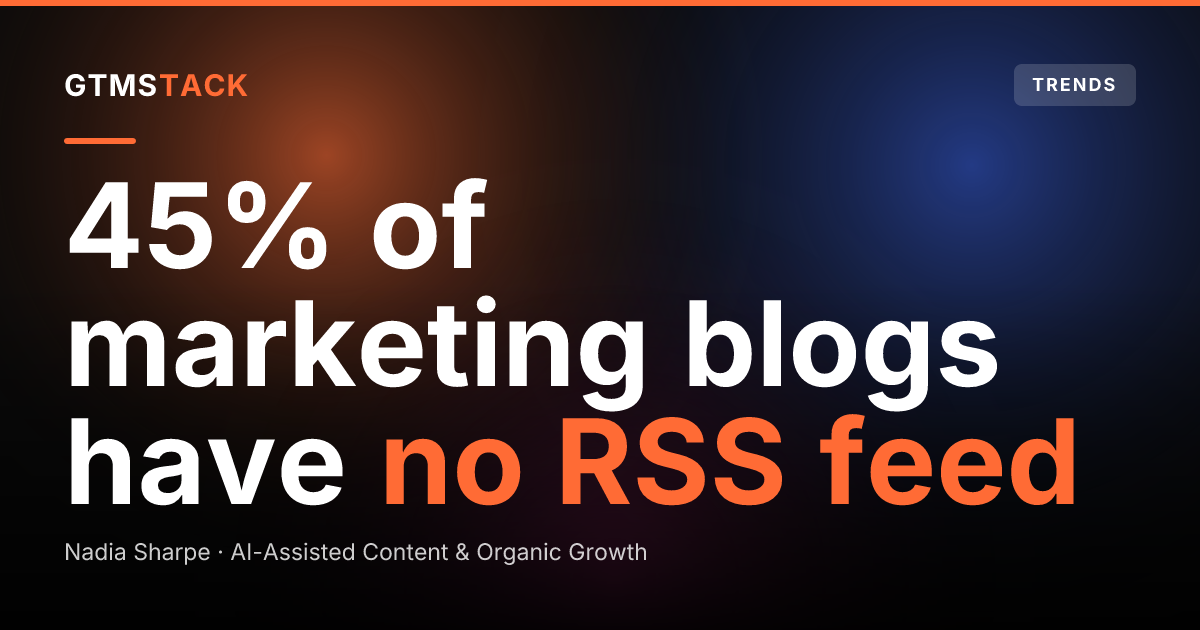
The Feedless Blog: 25 of 55 Marketing Publications Expose No RSS Feed
By Nadia Sharpe, AI Content & Organic. Last updated: 2026-08-16
We noticed this while building the corpus for our schema and byline audits: for 25 of 55 publications the crawler could not find a feed and had to fall back to rendering the blog index and guessing which link was the newest post. That fallback was a workaround. This is the finding it produced.
How many marketing blogs have an RSS feed?
We fixed the same 55-publication corpus as our other research audits: 20 independent titles and 35 vendor blogs. For each, we fetched the blog index and read every <link rel="alternate"> of type application/rss+xml or application/atom+xml, the way a feed reader's auto-discovery does. Then, whether or not the page advertised one, we probed 21 conventional feed paths relative to the blog path and the origin. A feed counted if it returned 200 with a body that opened with an <rss>, <feed> or <rdf> element and contained at least one item.
| Result | Publications | Share |
|---|---|---|
| Feed discovered | 30 | 54.5% |
| No feed found | 25 | 45.5% |
| By ownership | With feed | Share |
|---|---|---|
| Independent (20) | 14 | 70% |
| Vendor blog (35) | 16 | 46% |
Nearly half. For a format that WordPress emits by default, that is not drift; it is a generation of marketing sites built on platforms where the feed is opt-in and nobody opted.
Which publications have no feed?
Twenty-five. Six independent: MarketingProfs, Demand Curve, CXL, Marketing Week, Animalz and The Drum. Nineteen vendor: Klaviyo, Mailchimp Resources, Customer.io, Braze, Mixpanel, ActiveCampaign, Jasper, Copy.ai, Clearscope, Livestorm, ZoomInfo, Frase, lemlist, Apollo, Lusha, Pipedrive, Salesloft, Smartlead and Outreach.
The vendor list reads like a map of the modern marketing site stack. Webflow, custom Next.js builds and headless CMS front ends do not produce a feed unless someone builds one, and on these nineteen nobody did, or it lives at a path none of 21 conventions predicts. Mailchimp, a company whose product is sending content to subscribers, publishes a resources hub with no feed. Klaviyo, ActiveCampaign, Braze and Customer.io are in the same business and the same position.
The thirty with feeds are, disproportionately, the older platforms: WordPress-based publications (Search Engine Land at /feed, MarTech.org, Neil Patel, Social Media Examiner, Copyblogger, Backlinko) and vendors that kept the habit (HubSpot, Semrush, Ahrefs, Buffer, Hootsuite, Sprout Social, Amplitude, PostHog, Instantly, Close, Cognism, Vidyard).
Want to put this into practice?
Reachium automates LinkedIn outreach, content publishing, and inbox management in one platform.
Start Free →Why does a missing feed matter in 2026?
The obvious answer is subscribers, and it is the least important one. Feed readers are a niche audience for marketing content.
The less obvious answers are about machines. A feed is the cheapest, most reliable way for anyone to know a site published something: aggregators, syndication partners, monitoring tools, newsletter builders, and increasingly the ingestion pipelines that keep AI systems' knowledge current. A crawler can discover new posts by re-crawling the index and diffing, but that is expensive, laggy and error-prone, which is exactly the fallback our own crawler had to use for these 25, and it mis-picked hub pages for five of them. A site that wants its newest work read soon after it publishes, by anything other than a person clicking through, gives the machines a feed.
Feeds are also a freshness signal in their own right. Our undated-web audit found a third of year-titled marketing articles carry no machine-readable date; a feed with pubDate on every item is a second place that information can live, and the 25 publications without a feed lose that second place too. Along with dateModified in the Article schema, it is the low-cost infrastructure of being findable when you are new.
What are the limits of this audit?
Auto-discovery plus 21 conventional paths finds the overwhelming majority of feeds that exist, but a feed at an unconventional path with no rel="alternate" link would be missed, so the 25 is a ceiling on absence rather than a floor. Three publications' indexes were fetched via a rendering browser after blocking a plain request, and their auto-discovery links were read from the rendered DOM. Feed quality (full text versus excerpt, item count, update frequency) was not assessed. Snapshot of 2026-08-16.
FAQ
How many marketing blogs still have RSS feeds?
30 of 55 in this audit (55%). Independent publications are far likelier to have one (14 of 20) than vendor blogs (16 of 35).
Which major martech vendor blogs have no RSS feed?
Klaviyo, Mailchimp Resources, Customer.io, Braze, Mixpanel, ActiveCampaign, Jasper, Copy.ai, Clearscope, Livestorm, ZoomInfo, Frase, lemlist, Apollo, Lusha, Pipedrive, Salesloft, Smartlead and Outreach, as of 2026-08-16.
Why does an RSS feed matter if nobody uses feed readers?
Feeds are how aggregators, syndication partners, monitoring tools and AI ingestion pipelines learn that a site published something, without re-crawling and diffing the whole index. They also carry per-item publish dates.
How was feed availability checked?
By reading rel="alternate" RSS/Atom links from each blog index and probing 21 conventional feed paths, accepting any 200 response that opens with an rss, feed or rdf element and contains at least one item.
Which independent marketing publications lack a feed?
MarketingProfs, Demand Curve, CXL, Marketing Week, Animalz and The Drum, in this audit.
Want to put this into practice?
Reachium automates LinkedIn outreach, content publishing, and inbox management in one platform.
Start Free →Sources
- RSS 2.0 specification
- Atom Syndication Format (RFC 4287)
- WordPress feed documentation
- Search Engine Land feed
GTMStack publishes original audits of the AI marketing stack. If you want the next one when it lands, the newsletter is the place to get it.