By Theo Castellanos, AI Prospecting & Outbound Pipeline. Last updated: 2026-10-22
Consolidation is the martech story of 2026, and this is its largest chapter so far. Salesforce already owns the CRM record for a huge share of B2B and B2C companies. What it has historically been weaker at is the thing Braze was built for: reacting to live customer behavior in the moment, across mobile apps, web, email, SMS, and WhatsApp, at consumer scale. This explainer works from the acquisition release itself, filed with the SEC, and separates the announced facts from the interpretation layered on top of them. It is the second big platform deal we have unpacked this season, after Adobe's completed acquisition of Semrush, and the pattern across both is the same: incumbents are buying the layers AI made valuable.
What exactly did Salesforce announce?
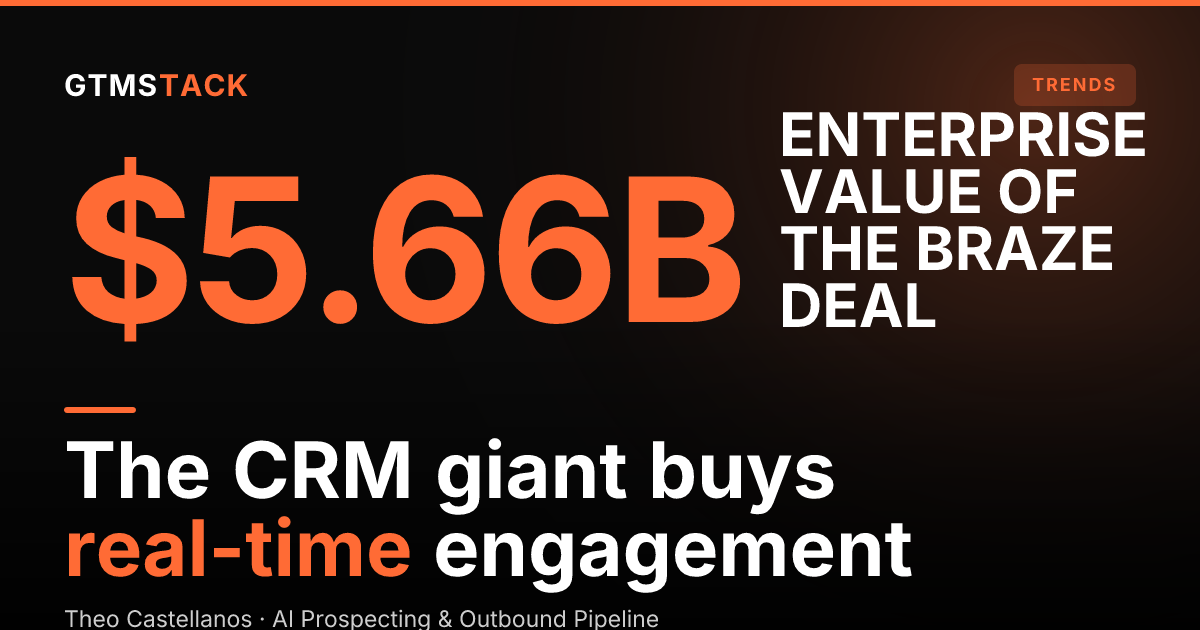
A definitive agreement, not a closed deal. The October 20, 2026 release, filed as an exhibit to Salesforce's SEC reporting, states the enterprise value (approximately $5.66 billion), the per-share cash consideration ($47.50 for Class A holders), and the closing conditions: Braze shareholder approval and required regulatory approvals. The expected close is Salesforce's fiscal year 2028, which runs from February 2027 through January 2028, so customers should plan on a long interim period where Braze operates as an independent public company under a pending deal.
The release also describes what Salesforce thinks it is buying. Braze's platform is "cloud-native, event-streaming architecture" optimized for high-volume, real-time B2C engagement, "powering trillions of messages and journey actions each year" (the companies' own description), with BrazeAI extending it into AI-powered optimization of content, offers, channels, and timing. Patrick Stokes, Salesforce's President of Applications and Marketing, framed the gap plainly: most of the "wow" in customer experience "comes from knowing your customer, and responding at just the right moment," and Braze "was built to turn live customer behavior into personalized engagement at scale."
Why does Salesforce want Braze inside Marketing Cloud?
Marketing Cloud has depth in email, advertising audiences, and B2B marketing automation, and a long-standing reputation for being powerful and cumbersome in equal measure. Braze's center of gravity is the opposite: marketer-friendly journey tooling built mobile-first, with real-time behavioral triggers as the core mechanic rather than a batch import. The release says Braze is expected to strengthen Marketing Cloud's cross-channel personalization, "helping brands turn a deeper view of each customer into richer experiences, optimized in real time."
Read alongside Salesforce's platform moves this year, the deal is also an agent play. Salesforce lists Agentforce as one of the four architecture layers Braze will complement, and its stated ambition is agentic solutions that "understand customers, make decisions, and act in real time." Braze's decisioning is a working, scaled version of exactly that inside engagement. It is the same logic that put Salesforce's whole platform behind agent-accessible interfaces earlier this year: the data and the decisioning are the assets; the interface is negotiable.
Want to put this into practice?
Reachium automates LinkedIn outreach, content publishing, and inbox management in one platform.
See Reachium →What should Braze customers do now?
Less than the news cycle suggests. The deal has not closed, the release commits to no product changes, and Magnuson's statement that Braze will "continue building as Braze and investing in the Braze community" is the only roadmap signal available. Three practical steps are still worth taking. Note your renewal date and contract terms, because post-close packaging questions are easier to negotiate from a documented baseline. Keep your event taxonomy and audience definitions portable: the asset that survives any platform migration is clean, well-documented behavioral data, not journey configurations. And watch the proxy and closing process rather than the commentary; the definitive proxy statement Braze files with the SEC will contain more operational detail than any analyst thread.
What should Marketing Cloud customers do?
Treat this as a signal about where Marketing Cloud investment is heading: real-time, mobile-deep, AI-decisioned engagement, likely with Braze technology absorbed over time rather than a separate product forever. If your team is mid-evaluation between Marketing Cloud and Braze, the pending deal is now a legitimate evaluation criterion in both directions: the combined roadmap may be stronger, and the integration period is unpriced. What the announcement does not justify is a rushed migration either way. Salesforce explicitly left its fiscal 2027 guidance unchanged and has not guided fiscal 2028, which is corporate language for: the financial and product integration story is not written yet.
How does this deal compare to the rest of the 2026 consolidation wave?
It rhymes with Adobe and Semrush: a platform incumbent paying a large premium (roughly 58% here, per Dow Jones) for a category leader whose value rose because AI changed the layer it sits on. Semrush owned visibility data in an AI-mediated discovery world; Braze owns real-time behavioral engagement in an agent-mediated messaging world. In both cases the acquirer already had the system of record and the distribution, and bought the capability that was hardest to build quickly. For a wider view of how often this pattern ends with the acquired product absorbed rather than preserved, our martech landscape mortality audit is the sobering read: independence after acquisition is the exception in this industry's history, whatever the first press release says.
Want to put this into practice?
Reachium automates LinkedIn outreach, content publishing, and inbox management in one platform.
See Reachium →FAQ
When will the Salesforce Braze deal close?
The companies expect the transaction to close in Salesforce's fiscal year 2028, which runs February 2027 through January 2028, subject to Braze shareholder approval and regulatory approvals. Until then Braze remains an independent public company.
How much is Salesforce paying for Braze?
Approximately $5.66 billion in enterprise value, with holders of Braze Class A common stock receiving $47.50 in cash per share, per the definitive agreement announced October 20, 2026.
Will Braze keep operating as its own product?
That is the stated intention for now. Braze CEO Bill Magnuson said in the announcement release that the company will "continue building as Braze," and Salesforce says Braze's capabilities will complement its architecture layers and strengthen Marketing Cloud. Post-close packaging has not been announced.
Does this change Salesforce's financial outlook?
Salesforce states there is no anticipated change to its fiscal 2027 guidance from the transaction, and it has not guided fiscal 2028. Any revenue or cost synergy claims beyond that are analyst speculation at this stage.
Should Braze customers start planning a migration?
No. The deal is pending, no product changes have been announced, and Braze continues to operate and ship. The prudent moves are documentation, not migration: record your contract terms, keep event and audience definitions portable, and follow the SEC proxy filings for concrete detail.
Sources
- Salesforce: definitive agreement to acquire Braze, full release filed with the SEC (Exhibit 99.1)
- Braze: Salesforce signs definitive agreement to acquire Braze (company press release)
- Morningstar (Dow Jones Newswires): Salesforce to buy customer-engagement platform for nearly $5.7 billion, including the premium to Braze's prior close
GTMStack publishes original audits of the AI marketing stack. If you want the next one when it lands, the newsletter is the place to get it.