By Priya Raman, AI SEO, GEO & Martech Analytics. Last updated: 2026-10-23
What counts as AI search visibility?
Three related measurements, often wrongly merged into one score.
- Mention rate. The share of sampled answers that name your brand at all.
- Citation rate. The share of sampled answers that cite or link one of your pages as a source.
- Share of voice. Your mentions as a share of all brand mentions across a defined competitor set, for the same prompt set and period.
A brand can score well on one and badly on another. Strong mention rates with weak citations usually mean the market talks about you but answer engines source the details elsewhere. Strong citations with weak mentions usually mean your pages inform answers that recommend competitors. Those are different problems, which is why the series stay separate. The split also runs across engines, which is its own trap for anyone reading a single number: why AI visibility scores differ by engine walks through the per-engine mention and citation gaps and why one blended score misleads.
How do you build the prompt set?
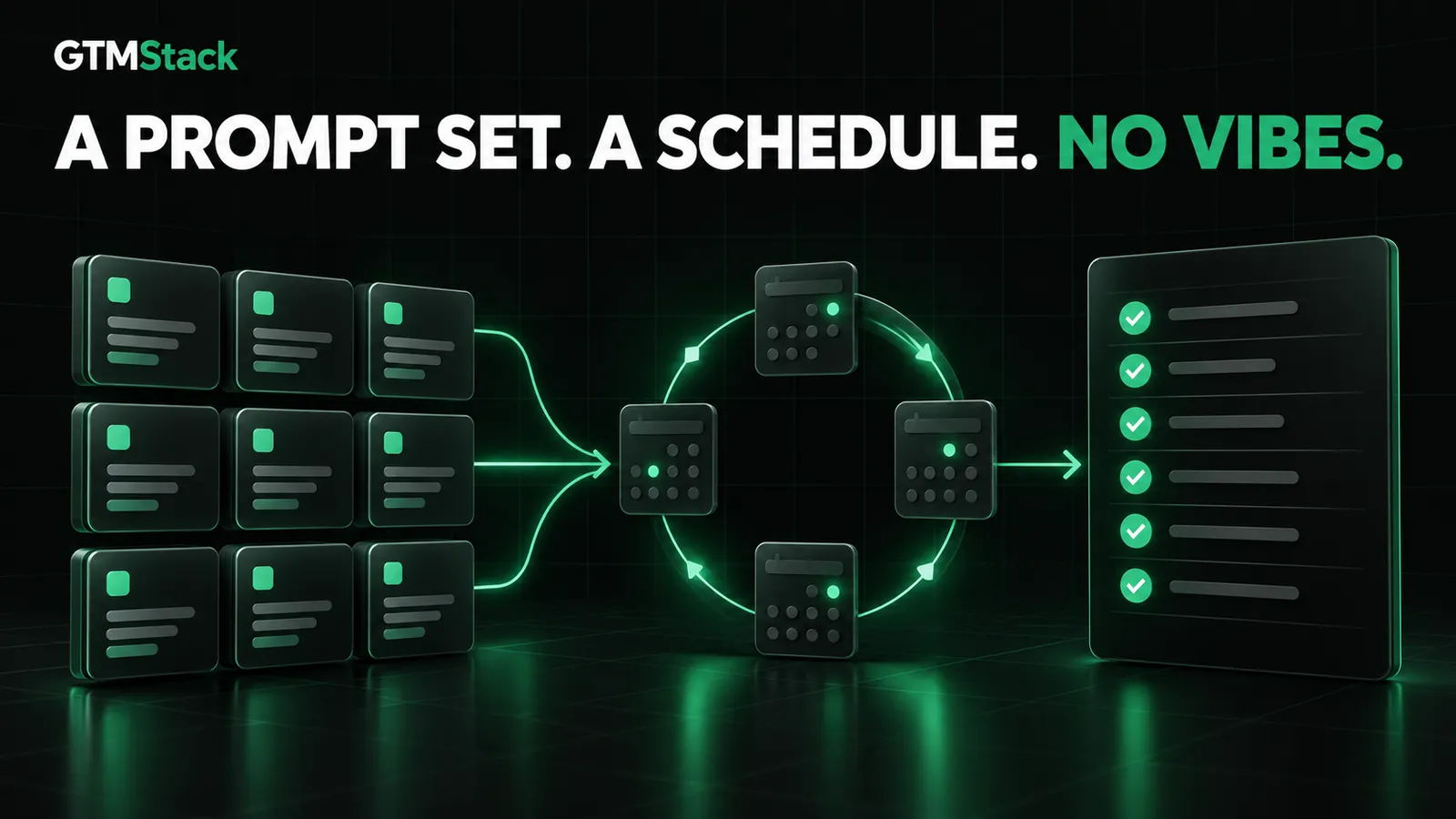
Write prompts the way buyers write them, not the way your homepage talks. Cover four families: category prompts (best tools for a job), problem prompts (how to fix a named pain), comparison prompts (named alternatives), and use-case prompts (a role, a company size, a task). Keep the set small enough to run completely and consistently, and version it like code: changes are dated, and trend breaks are annotated when the set changes. Pull candidate prompts from sales calls, search console queries, and the questions your content already ranks for, rather than inventing them at a whiteboard.
Want to put this into practice?
Reachium automates LinkedIn outreach, content publishing, and inbox management in one platform.
See Reachium →How often should you re-run checks?
On a fixed schedule, and more than once per period. Answer engines are not deterministic: the same prompt can surface different brands across sessions and days. A single run therefore overstates precision. Run the set multiple times per reporting period, report the average and the spread, and investigate prompts where your presence flickers, because unstable prompts are usually the closest to winnable. Record engine, date, location and account state for each run, since answers can vary with all four.
What do you do with the results?
Read the answers, not just the counts. The cited pages show you the structure, sourcing, and specificity the engine trusted, which is the practical input to your content work. Our guide on how to get cited by ChatGPT covers earning the citation, and track AI citations covers the ongoing logging. At portfolio level, visibility trends belong next to the statistics in our generative engine optimization statistics coverage, so movement is read against the wider market rather than as isolated wins.
FAQ
What is AI share of voice? Your brand's mentions divided by all tracked brands' mentions across the same prompt set and period. It only means anything when the prompt set and competitor set stay fixed between periods.
How do I check if ChatGPT recommends my brand? Ask the prompts your buyers would ask, in a clean session, more than once, and record the full answer including which competitors appear and which pages are cited. One ask in one session is a sample of one.
How many prompts does a useful set need? Enough to cover your buying questions honestly, few enough to run in full every period. A focused set run consistently beats a large set run once. Start with the questions that precede a purchase conversation and expand only when you can sustain the cadence.
Mentions vs citations: which matters more? Both, for different decisions. Mentions track brand presence in the answer. Citations track whether your own content is the evidence. For pipeline, the citation is the one that can bring the reader to you, which is why it is scored separately rather than blended away.
Can I measure this without a paid tool? Yes, at small scale, with a spreadsheet, a fixed prompt set, and scheduled manual runs, accepting the time cost and the sampling limits. Paid tools automate collection and history. They do not change the method, which is why the method is worth fixing first.
Want to put this into practice?
Reachium automates LinkedIn outreach, content publishing, and inbox management in one platform.
See Reachium →Sources
- GTMStack queue of record, .saeo/keywords.yaml, entry "how to measure ai search visibility": SERP and method research sampled 2026-10-21 (fixed prompt sets, mention vs citation, share of voice, repeat sampling).
- Internal link targets: /get-cited-by-chatgpt, /track-ai-citations, and /generative-engine-optimization-statistics (live); /ai-search-visibility-tools (staged in the same batch).
Linked sources: