Generative Engine Optimization Statistics: What the Data Says
By Priya Raman, AI SEO, GEO & Martech Analytics. Last updated: 2026-10-21
What is the headline statistic behind generative engine optimization?
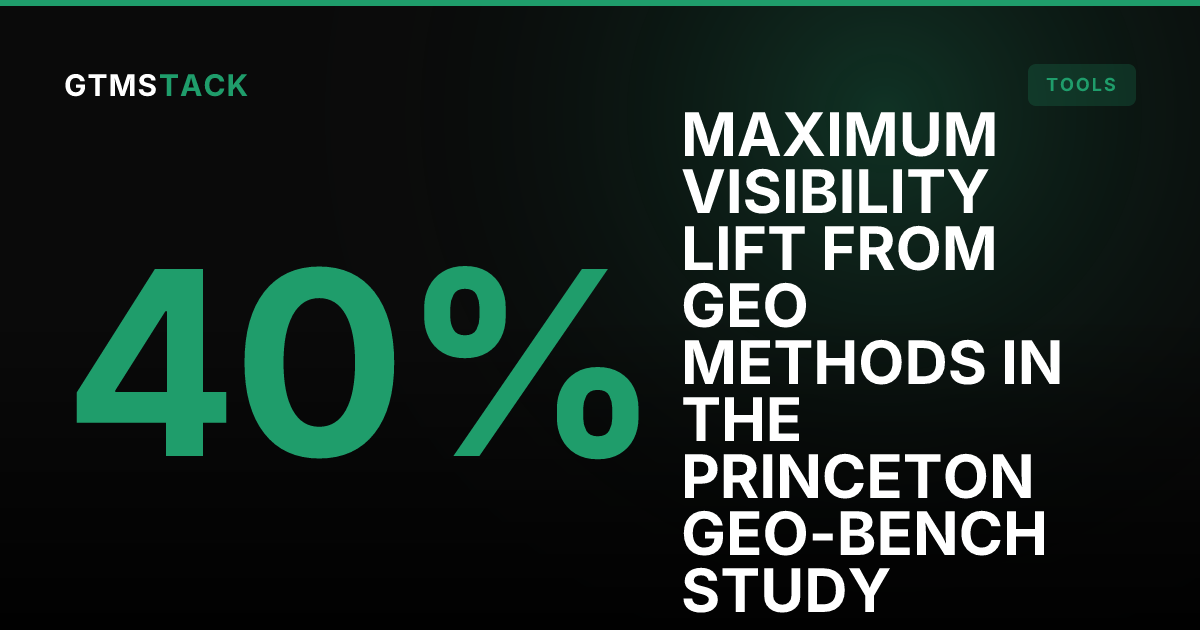
The field starts with one number: up to 40%. In the paper that named the discipline (Aggarwal and co-authors, from Princeton, Georgia Tech and partners, published at KDD 2024), the researchers introduced GEO-bench, a large benchmark of generative-engine queries, and measured how content changes affected a page's visibility inside generated answers. Their finding: GEO methods can boost visibility by up to 40% in generative engine responses.
Two qualifiers from the same paper matter more than the headline. First, "up to" is a ceiling, not an average; typical gains are lower. Second, the authors found the efficacy of strategies varies across domains, which is why generic GEO checklists underperform domain-specific testing. If a vendor quotes the 40% without either qualifier, they are selling, not informing. Our explainer on what generative engine optimization is covers the methods themselves.
How much do AI summaries change whether people click at all?
Pew Research Center measured real behavior instead of rankings. Its July 2025 study analyzed the browsing of 900 U.S. adults across March 2025, covering 68,879 Google searches. The results:
- When an AI summary appeared, users clicked a traditional result link in 8% of visits. Without a summary, they clicked in 15% of visits.
- Users clicked a link inside the AI summary itself in about 1% of visits. Being cited is visibility; it is rarely a click.
- Users ended their browsing session after 26% of searches that showed a summary, against 16% of searches without one.
The honest reading: AI summaries roughly halve the click-through to the open web on affected searches, and the citation itself almost never produces the visit. GEO value shows up as presence inside the answer, branded search lift and downstream demand, which is why the measurement stack in our guide to tracking AI citations matters more than a rank report.
Want to put this into practice?
Reachium automates LinkedIn outreach, content publishing, and inbox management in one platform.
See Reachium →What happens to the top-ranking page when an AI Overview appears?
Ahrefs studied the position-one effect directly, using aggregated Google Search Console data across 300,000 keywords, half showing an AI Overview and half informational without one. Its April 2025 analysis found the presence of an AI Overview was associated with a 34.5% lower click-through rate for the top-ranking page. When Ahrefs re-ran the study on December 2025 data (published February 2026), the gap had grown: a 58% lower average click-through rate for the top-ranking page when an AI Overview appears.
Both figures are correlations from observational data, not experiments, and Ahrefs says so. Read together with Pew, though, the direction is consistent across two independent methods: the summary absorbs the click that position one used to collect. The strategic consequence is the core of the GEO vs SEO argument: ranking still matters, because engines cite what ranks, but the citation is now the prize the ranking buys.
Which GEO outcomes should a team actually report?
Given the evidence above, three metrics survive scrutiny:
- Citation rate: how often your pages are cited in AI answers for your target queries, sampled on a schedule. It is the direct analogue of the visibility metric in the Princeton study.
- AI referral sessions: traffic arriving from ChatGPT, Perplexity and similar surfaces. Small in absolute terms (Pew's 1% figure sets expectations), but it is real, measurable demand.
- Branded search trend: the downstream signal that repeated citation is creating recognition. It lags the other two and confirms them.
What not to report: any single "GEO score" from a tool that will not show its method, and any statistic whose original study you cannot open. Every number in this post links to a source a skeptic can check in one click, including the study this publication's GEO explainer is built on. That is the standard the category should be held to.
GTMStack publishes new breakdowns on AI-powered marketing every week. If you want the next one on GEO, AI content, and the LinkedIn playbook, subscribe to the newsletter and we will send it to your inbox.
FAQ
What is the most cited GEO statistic?
The up to 40% visibility lift from the original GEO paper (Aggarwal et al., KDD 2024), measured on the GEO-bench benchmark. It is a maximum across methods and domains, not a typical result, and the paper itself stresses that efficacy varies by domain.
Do AI Overviews reduce organic clicks?
The observational evidence says yes. Pew found users clicked traditional results in 8% of visits when an AI summary appeared, versus 15% without. Ahrefs found position-one click-through rates 34.5% lower with an AI Overview present in April 2025 data, and 58% lower in its December 2025 update.
How often do people click the sources cited in an AI summary?
Rarely. Pew measured clicks on links inside the summary in about 1% of visits. Citations still matter because they drive recognition and branded search, but they should not be forecast as referral traffic.
Where do these GEO statistics come from?
Three named sources: the GEO paper by Aggarwal and co-authors (arXiv:2311.09735), Pew Research Center's July 2025 short read on AI summary click behavior, and Ahrefs' AI Overviews click studies from April 2025 and February 2026. Each is linked in Sources below.
Want to put this into practice?
Reachium automates LinkedIn outreach, content publishing, and inbox management in one platform.
See Reachium →