How Google AI Overviews Are Changing Search Traffic
By Priya Raman, AI SEO, GEO & Martech Analytics. Last updated: 2026-05-19
If you run B2B marketing, the dashboard you trusted is lying to you by omission. Sessions are down, but rankings held. The position did not move; the click disappeared into an AI summary. This post unpacks the measured numbers behind that gap, and what it means for where you put your next hour of content work.
- Your top pages can rank and still lose traffic, because the answer now sits above them.
- Paid clicks are falling on the same queries, so buying your way back is getting more expensive.
- The channels that survive this shift are the ones you own outright, not the ones you rent from an algorithm.
What is the AI overviews traffic impact on click-through rates?
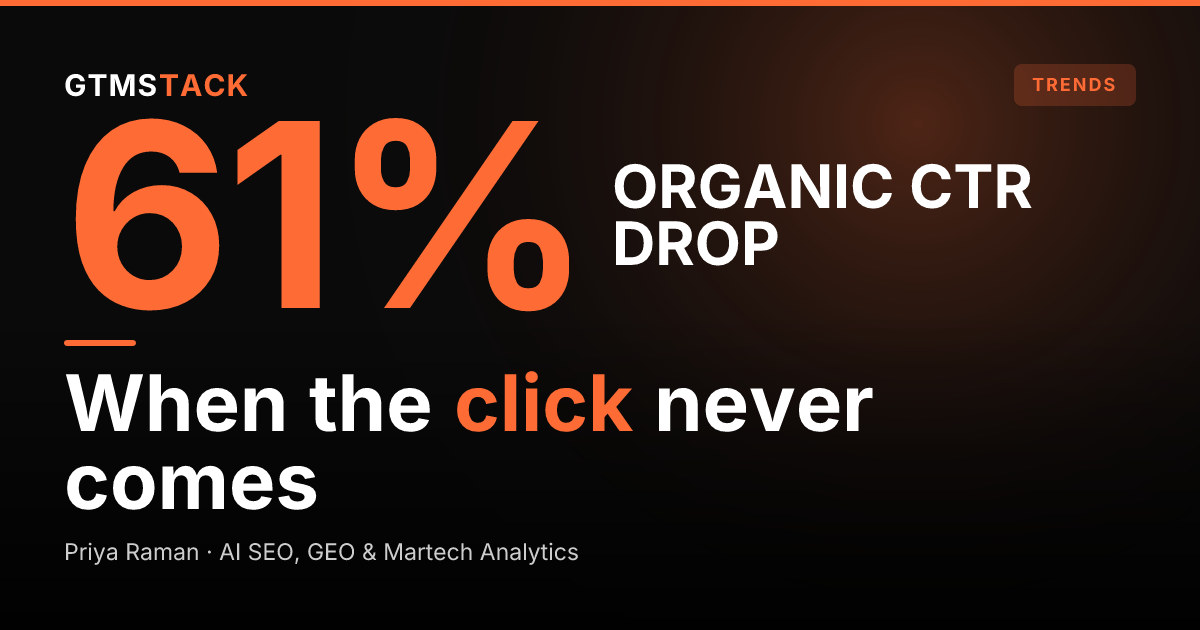
The AI overviews traffic impact is a sharp drop in click-through, even when your ranking does not change. Seer Interactive found organic CTR on queries that trigger an AI Overview fell 61% against a June 2024 baseline, from 1.76% down to 0.61%. That is the click vanishing while the rank holds.
Paid results took an even harder hit on the same query set. Seer's data, reported through Search Engine Land, shows paid CTR plunging 68% on AI Overview queries, from 19.7% to 6.34%. So the answer box compresses both sides of the page: the free clicks you earned and the clicks you paid for shrink together. That breaks the usual escape hatch, because you cannot simply outbid the gap when the ad clicks are collapsing too.
The mechanism is straightforward. When Google answers the question inside the results page, the user has fewer reasons to leave it. The summary satisfies the intent, names a couple of sources, and sends most people on their way without a visit. For a marketing leader being asked to prove sourced pipeline, that is a structural problem, not a seasonal dip. The pages still rank, but the rank stopped converting into sessions you can attribute.
How bad is the zero-click problem in 2026?
Zero-click search is now the default behavior on a large share of queries, and AI Overviews make it worse. Searches that trigger an AI Overview show an average zero-click rate of 83%, compared with 60% on traditional queries, according to Semrush data compiled by Click-Vision. More than four in five of those searches end without a single outbound click.
That 23-point gap is the cost of the answer box sitting above your link. It is not that your content is weaker; it is that the surface changed underneath it. The user got what they needed before they reached your result. For informational queries, which is where most top-of-funnel B2B content competes, this is the queries you most want to win quietly becoming the queries that send the least traffic.
There is a thin silver lining, and it matters for strategy. Seer found that brands cited inside AI Overviews earn 35% more organic clicks than non-cited competitors. So being named in the summary is now a real position worth fighting for, which is the whole premise of generative engine optimization: structuring content so AI engines retrieve and cite it. The catch is that one citation slot, shared across a few brands, does not replace a full page of ranked links. You can win the citation and still net fewer total sessions than you had two years ago.
Want to put this into practice?
Reachium automates LinkedIn outreach, content publishing, and inbox management in one platform.
See Reachium →Where is the traffic going instead, and is any of it good?
The traffic is fragmenting toward AI platforms and away from the traditional results page. ChatGPT reached more than 800 million weekly active users by October 2025, and Perplexity passed 230 million monthly active users in Q1 2026 with 184% year-over-year growth, the fastest of any major AI search platform. Buyer research is moving into these tools, and a slice of it sends referral traffic back out.
Here is the part that should change your priorities: the traffic that does arrive from AI engines converts unusually well. A 13-month Search Engine Land analysis found LLM-referred users convert at roughly 18%, against about 2.8% for traditional organic search. The volume is smaller, but the intent is far higher, because someone who clicks through from an AI answer has already been pre-qualified by the conversation. This is why tracking which engines mention you, covered in our guide to tracking AI citations, is becoming a core reporting line rather than a curiosity.
So the picture is not pure decline; it is redistribution. Fewer total clicks from search, a harder paid environment, and a new, smaller, higher-converting stream from AI surfaces. Winning that stream means being citable, and being citable means earning a spot inside answers on platforms like Perplexity, which we break down in how to show up in Perplexity. The marketing leaders who adapt fastest are treating AI citation as the new top-of-funnel position.
Why are owned channels the safer bet for attributable pipeline?
Owned channels are the safer bet because no algorithm can insert a summary between you and an audience that already follows you. When 83% of AI Overview searches end without a click and organic CTR is down 61%, the rational hedge is to build distribution you do not have to win back every quarter. A subscriber list, a newsletter, and an engaged social following are assets that route attention directly, with no answer box in the middle.
For B2B specifically, the strongest owned wedge is LinkedIn. The platform reaches 1.3 billion members, 89% of B2B marketers use it for lead generation, and it converts at 277% higher rates than Facebook and X, per Sopro. Unlike a search ranking, a LinkedIn post lands in feeds you have already earned, and a comment-triggered lead magnet captures intent inside the platform rather than hoping for a click that the AI summary now intercepts. The same owned-channel logic that protects you from AI Overviews is why LinkedIn engagement maps so cleanly to pipeline, which we quantify in our LinkedIn outreach benchmarks.
This is not an argument to abandon SEO. Ranking still matters, and being cited in AI Overviews is now part of that work. The argument is about portfolio balance. If search traffic is becoming less predictable and less attributable, the marketing leader who can show sourced pipeline is the one who diversified into channels where the relationship, not the ranking, owns the audience. AI Overviews did not kill demand; they relocated control, and owned channels are where you get it back.
GTMStack tracks how AI search, owned channels, and attribution keep shifting under B2B marketers. Subscribe to the GTMStack newsletter for more data-backed AI-marketing breakdowns like this one.
FAQ
What is the AI overviews traffic impact on my existing rankings?
Your rankings can stay flat while your traffic falls, because the AI Overview sits above your result and answers the query first. Seer Interactive measured a 61% drop in organic CTR on AI Overview queries even as positions held. The position is no longer a reliable proxy for sessions, so you should report clicks and sessions separately from rank.
Do AI Overviews hurt paid search too?
Yes, and the data suggests they hurt paid results more than organic. Seer's analysis reported through Search Engine Land found paid CTR on AI Overview queries fell 68%, from 19.7% to 6.34%. That means you cannot reliably bid your way around the lost organic clicks, because the ad clicks are compressing on the same queries.
How do I get cited inside an AI Overview?
Structure content so an engine can lift and attribute it: lead with sourced statistics, write quotable standalone sentences, and cite authoritative sources. Seer found brands cited in AI Overviews earn 35% more organic clicks than non-cited competitors, so the citation slot is worth pursuing. This is the core discipline of generative engine optimization.
Should I shift budget from SEO to LinkedIn because of AI Overviews?
Not entirely, but rebalancing toward owned channels is rational when 83% of AI Overview searches end without a click. LinkedIn reaches 1.3 billion members and converts at 277% higher rates than Facebook and X for B2B, and it routes attention directly with no answer box in the middle. Keep SEO and GEO running, and add owned distribution you do not have to win back each quarter.
Want to put this into practice?
Reachium automates LinkedIn outreach, content publishing, and inbox management in one platform.
See Reachium →Sources
- Seer Interactive: AI Overviews impact on Google CTR (September 2025 update)
- Search Engine Land: Google AI Overviews drive drop in organic and paid CTR
- Click-Vision / Semrush 2025 zero-click search statistics
- Search Engine Land: what 13 months of data reveals about LLM traffic and conversions
- Sopro: LinkedIn lead generation statistics 2025