Winning B2B in a Zero-Click, AI-Answer World
By Priya Raman, AI SEO, GEO & Martech Analytics. Last updated: 2026-08-06
If you run marketing and your board grades you on sourced pipeline, zero-click search is not an abstract SEO trend. It is a direct threat to the channel you reported last quarter. The traffic that used to arrive, fill a form, and show up in the attribution model is being intercepted by an AI answer that names a source and moves on. This piece covers what zero-click search actually changes, and why owned distribution is the response that protects your number.
- You are told to prove LinkedIn drives attributable pipeline, not vanity reach.
- Generic AI posts get blamed for impressions that never become leads.
- Search referrals are shrinking while AI answers absorb the click.
What is zero-click search, and why does it break the old playbook?
Zero-click search describes a query that the searcher resolves without clicking through to any website, because the answer is delivered on the results page itself or inside an AI engine's response. For B2B, it breaks the old playbook because the assumption underneath that playbook, that ranking earns a visit, no longer holds.
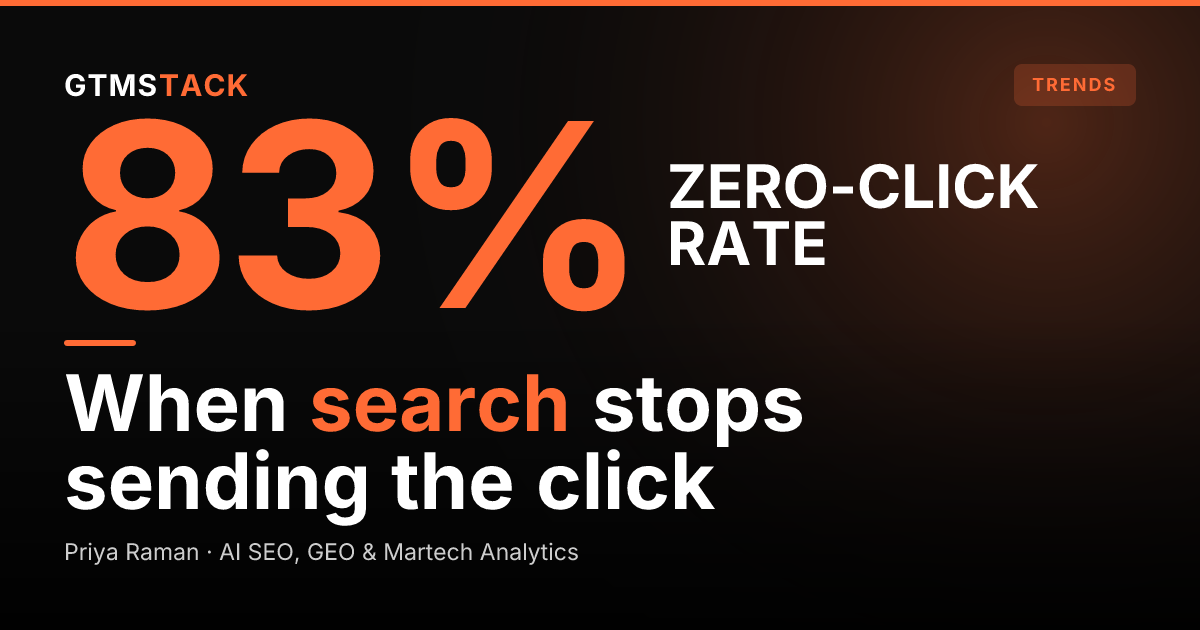
The numbers are no longer marginal. Searches that trigger an AI Overview show an average zero-click rate of 83%, compared with 60% for traditional queries, according to a 2025 zero-click analysis from Click-Vision and Semrush. Organic click-through rate on AI Overview queries dropped 61% from its June 2024 baseline, from 1.76% to 0.61%, in Seer Interactive's September 2025 study. Paid CTR on the same queries fell 68%. The click you used to win by ranking is being intercepted before it leaves the results page.
The behavior shift is structural, not seasonal. ChatGPT reached more than 800 million weekly active users by October 2025, and Perplexity passed 230 million monthly active users in Q1 2026 with 184% year-on-year growth, the fastest of any major AI search platform. Buyers are doing research inside answer engines that summarize and cite, then skip the rest. If your strategy still assumes the visit is the unit of value, the model is mispriced.
Why does owned distribution beat chasing clicks in a zero-click world?
Owned distribution wins because it removes the intermediary that is now keeping the click. When you publish where your audience already is and capture them into a channel you control, no algorithm change or AI summary stands between your content and your buyer. Borrowed reach gets taxed; owned reach does not.
There are two practical reasons this matters for pipeline. First, the audience math favors LinkedIn for B2B: 89% of B2B marketers use it for lead generation and it converts at 277% higher rates than Facebook and X, per Sopro's 2025 LinkedIn statistics, and 98% of B2B marketers use it for content, per Demandsage. Second, the people who do click from AI surfaces are unusually valuable: LLM-referred users convert at roughly 18%, against 2.8% for traditional organic search, in Search Engine Land's 13-month analysis. The lesson is not "ignore AI search". The lesson is that volume is collapsing while quality concentrates, so you build assets that earn the high-intent visit and the owned follow-up rather than betting the quarter on raw traffic.
This is also why getting cited still counts. Brands cited in AI Overviews earn 35% more organic clicks than non-cited competitors, so structuring content to be quoted (the discipline behind how to structure content so AI engines quote it) feeds the same flywheel. The owned-distribution move and the citation move are complements: one captures the audience, the other keeps you visible inside the answer. To go deeper on the citation side, start with generative engine optimization and the broader category of work it names.
Want to put this into practice?
Reachium automates LinkedIn outreach, content publishing, and inbox management in one platform.
See Reachium →What should you post on LinkedIn to actually generate leads, not just reach?
Post content that turns attention into a captured contact, which in practice means pairing a useful, quotable post with a lead magnet that moves engagement into a conversation. Reach that nobody can follow up on is the vanity metric your board is worried about; a comment that becomes a DM is pipeline you can attribute.
Format and length both move the needle, and the data is specific. Document posts (PDF carousels) hit a 6.60% engagement rate, 278% more than video and 596% more than text-only, in Socialinsider's 2026 LinkedIn benchmarks, while LinkedIn video views dropped 36% year over year. On length, tighter is better: the feed truncates essays and readers rarely click through. The takeaway is to write tight, lead with a standalone claim, and choose a format the algorithm is currently rewarding. The same quotable-claim discipline that wins a LinkedIn save also feeds AI citation, so anchor your tooling decisions to a roundup of AI SEO tools compared and keep the writing structured for both surfaces.
How do you attribute LinkedIn content to pipeline so it survives a budget review?
You attribute LinkedIn content to pipeline by instrumenting the capture step, not the impression: track the comment-to-DM conversion, the contacts captured by lead magnets, and the meetings those conversations produce, then tie those records to opportunities in your CRM. Impressions are a leading indicator; captured contacts and booked meetings are the line items a budget review respects.
This is where owned distribution proves its case on a spreadsheet. Reachium's platform benchmarks give you the denominators: in the published benchmarks, connection acceptance averages 27.11%, accepted connections reply 27.55% of the time, and 1.99% of accepted connections book a meeting. Knowing those rates lets you forecast pipeline from activity rather than guess, and it lets you defend the channel with a model instead of a screenshot. For the full benchmark set behind those numbers, see the LinkedIn outreach benchmarks for 2026. The discipline is the same one you apply to AI search: measure the captured outcome, accept that some attribution is imperfect, and report the trend in pipeline rather than the decimal in reach.
FAQ
Is zero-click search going to kill B2B SEO?
Zero-click search is shrinking the clicks that ranking earns, but it is not killing the value of being found. The shift moves the prize from a visit to a citation and a captured contact. The durable response is to keep producing crawlable, quotable content while building owned distribution on LinkedIn and email so you are not dependent on the click.
What should I post on LinkedIn to get leads instead of reach?
Post tight, quotable content paired with a lead magnet that converts engagement into a DM. Document carousels hit 6.60% engagement in Socialinsider's 2026 benchmarks, and tight, claim-first posts travel further than essays. Lead with a standalone claim, then give readers a way to raise their hand.
How do I attribute LinkedIn content to pipeline?
Instrument the capture step, not the impression. Track comment-to-DM conversions, contacts captured by lead magnets, and the meetings those conversations create, then tie each record to a CRM opportunity. Use known benchmark rates, such as Reachium's published 27.11% acceptance and 1.99% accepted-to-meeting figures, to forecast pipeline from activity rather than guess.
Why do LLM-referred visitors convert better than organic search visitors?
LLM-referred users arrive with the answer engine having already done qualification, so they tend to land closer to a decision. Search Engine Land's 13-month analysis put their conversion rate near 18%, against 2.8% for traditional organic search. The practical implication is that volume is falling while intent concentrates, so capturing those high-intent visitors matters more than chasing raw traffic.
Want to put this into practice?
Reachium automates LinkedIn outreach, content publishing, and inbox management in one platform.
See Reachium →