By Dev Anand, AI Tooling & Automation Safety. Last updated: 2026-10-23
What does a templated email actually personalize?
Less than the word suggests. A template fixes the message: the opener's shape, the problem statement, the proof, the call to action. Personalization tokens then substitute data into slots: a name here, a company there, occasionally a title or an industry label. Two prospects in different situations receive the same argument wearing different name tags.
This is not a criticism of templates as such. A well-written template encodes a tested argument and keeps a program consistent, and for genuinely uniform audiences, a shared problem at a shared moment, substitution may be all the relevance the message needs. The limit appears when the audience is heterogeneous: the template cannot notice that one prospect just opened a new office, another just posted about the exact problem you solve, and a third has no connection to the problem at all. It sends all three the same reasoning, and readers have learned to recognize that reasoning on sight.
What does AI personalization change?
AI personalization moves the per-prospect decision earlier, from filling slots to drafting content. Given signals about an individual prospect, a model can select which observation to open with, frame the problem in the prospect's own context, choose the most relevant proof point from a set you provide, and adjust length and tone. The strategy, the offer, the claims allowed, and the guardrails stay human decisions. The expression of that strategy for this reader becomes generated rather than substituted.
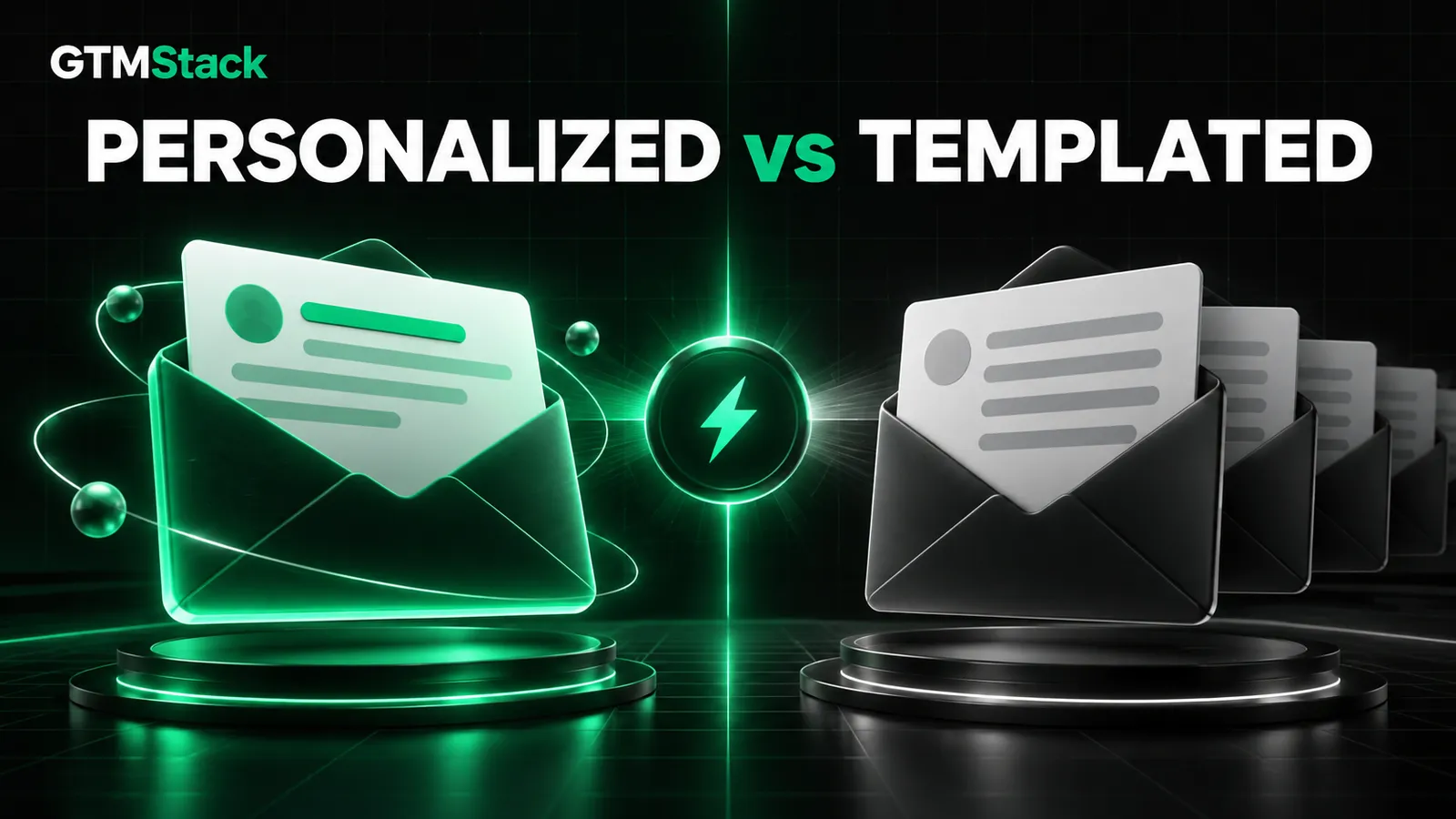
The practical test is simple. Put two messages to two different prospects side by side. If only the names and company names differ, you are looking at a template, whatever the tool calls itself. If the opening observation, the framing, and the reason for writing genuinely differ because the prospects differ, you are looking at AI personalization. A large share of tools marketed as AI personalization fail this test: they generate one template with a model once, then mail-merge it, which is templating with an extra step and the same generic result.
Want to put this into practice?
Reachium automates LinkedIn outreach, content publishing, and inbox management in one platform.
See Reachium →Where does each approach break?
Templates break on relevance. The reader recognizes the pattern, often within the first line, and the message is classified as bulk mail regardless of how accurate the merged fields are. Worse, a single wrong field, a misspelled name, a company the prospect left, exposes the machinery and damages the sender more than no personalization would have.
AI personalization breaks on truth. A model working from thin or stale signals can produce a fluent reference to an event that never happened, a post the prospect did not write, or a problem their company does not have. To the reader, that is worse than generic: generic is ignorable, while specific and wrong reads as careless or deceptive. This failure mode is why the workflow matters more than the model: verified signals in, generated draft in the middle, human approval before sending, and a hard rule that any specific claim the system cannot support gets cut rather than softened.
There is also a shared failure underneath both: volume temptation. Because generation is cheap, teams widen lists and raise send counts, and the deliverability and reputation costs arrive on schedule. Personalization quality and sending discipline have to rise together, or the better copy simply reaches the spam folder more eloquently.
How should a team combine the two?
Use each where it is strong. Let a human-written template own the parts that should never vary: the offer, the compliance lines, the structure of the ask, and the claims the company stands behind. Let AI generation own the parts that should vary: the opening observation drawn from a verified signal, the framing matched to the prospect's situation, and the selection among approved proof points. Let a human own the send decision on anything the system flags as low-confidence.
That division keeps the message honest at scale. The template guarantees consistency. The generated layer earns the reader's first five seconds. The review step keeps fluent errors out of real inboxes. Judged as a system, the question in this post's title answers itself: the difference is not the presence of AI, it is which decisions are made once for everyone and which are made again for each reader.
FAQ
Is AI-personalized email just mail merge with better tokens? No, when it is done properly. Mail merge substitutes values into a fixed message. AI personalization generates message content per prospect from signals about that prospect, so the substance differs between readers. If a tool only swaps richer fields into the same text, it is mail merge with better tokens, regardless of its marketing.
Does AI personalization guarantee higher reply rates? No honest source can guarantee that, and this post cites no reply rate figures for either approach. Personalization removes one common reason for deletion, visible genericness, and adds one new risk, confident inaccuracy. Outcomes depend on list quality, signal quality, review discipline, and deliverability, which is why controlled tests on your own list are the only evidence that should settle the question for your program.
What signals should AI personalization use? Signals that are recent, public, and verifiable: the prospect's own posts and announcements, company news such as funding, hiring, or expansion, and role changes. Signals scraped from stale databases or inferred from thin data produce the confident errors described above. If a signal cannot be checked quickly by the human reviewer, it should not anchor a message. And when the same budget could go to a different channel entirely, cold email vs LinkedIn is the comparison that frames the choice.
Can templated email still be the right choice? Yes. For a narrow audience facing the same trigger at the same moment, a strong human-written template with accurate fields can be the honest, effective option, and it carries no hallucination risk. AI personalization earns its complexity when audiences are broad enough that one fixed argument stops fitting the readers inside it.
Want to put this into practice?
Reachium automates LinkedIn outreach, content publishing, and inbox management in one platform.
See Reachium →Sources
- Internal posts cited by slug: /ai-cold-email-personalization (activity-based personalization practice), /cold-email-deliverability-checklist (the deliverability preconditions). Live posts, checked 2026-10-23.
- No reply rate or performance statistics are cited in this post, deliberately. Comparative performance claims for personalization approaches are vendor-reported in the available literature, and this post makes only structural claims a reader can verify against their own sends.
Linked sources: