Stop Sending 100 LinkedIn Connection Requests a Day
By Jonah Beckett, Founder-Led Growth & Revenue. Last updated: 2026-08-06
Most LinkedIn growth advice still tells you to push volume to the ceiling. The logic feels obvious: more invites equals more accepts equals more pipeline. The data says the opposite. Volume past a tight band actively works against you, and the accounts that send the most are not the ones that book the most.
- You are sending 100 invites a day and watching your acceptance rate sink.
- Your reply rate keeps dropping even though your message has not changed.
- You feel one bad week away from a temporary restriction.
How many LinkedIn connection requests should you send per day?
Fewer than you have been told. The sweet spot is 10-19 invites a day, not the 100-a-day pace that automation vendors built their pricing around. At that lower band, every invite carries more signal and lands on a sharper list, which is why the accept rate climbs rather than falls.
LinkedIn's own published guidance caps invitations at roughly 100 per week, which works out to about 14 a day if you spread them across a working week. The platform's invitation limit documentation is explicit that weekly invites are throttled, and that ceiling exists because LinkedIn treats high-volume sending as a spam risk. Sending 100 a day is not just inefficient, it runs straight into a weekly wall the platform designed to stop you.
The reason 10-19 a day wins is not a quota you are gaming. It is that a small daily number forces you to be selective, and selectivity is what acceptance rate actually measures. When you cannot send to everyone, you send to the right people, and the right people accept.
Why does sending more requests lower your acceptance rate?
There is a volume tax, and Reachium measured it directly. In its volume-tax study across the full matured cohort, acceptance peaked at 32.01% for accounts sending 10-19 invites a day, then dropped to 26.65% in the 20-29 a day band. More invites produced fewer accepts per invite, not more. The study also keeps the advice honest in the other direction: the under-10 band performs worst of all at 22.77%, so the target is the 10-19 sweet spot, not minimal sending. The platform caps sending around 25 invites a day by design for exactly this reason, and active accounts average 22.42 invites on a sending day.
The mechanism is straightforward. When you scale volume, you run out of high-fit prospects fast, so the marginal invite goes to someone who fits less well and is less likely to accept. Volume also changes your behavior: you stop reading profiles, you stop personalizing, and your invites start to read like a blast. LinkedIn's relevance systems notice low-quality acceptance patterns, and your reach quietly degrades. The firehose does not just dilute your list, it trains the algorithm to trust you less.
This is not a one-off reading. The full benchmark dataset shows the same shape across the whole window, and the full LinkedIn outreach benchmarks back this up with the segment-by-segment numbers. Acceptance held steady near 25-30% for disciplined accounts while reply quality, not volume, separated the winners.
Want to put this into practice?
Reachium automates LinkedIn outreach, content publishing, and inbox management in one platform.
See Reachium →What does high-volume outreach actually cost you?
The cost is your list, your reply quality, and your account health, all at once. A finite pool of in-market decision-makers exists in any niche, and a 100-a-day pace burns through it in weeks. Once you have invited everyone twice, you are left with a cold, exhausted list and no obvious next move.
Reply quality erodes alongside it. Reachium data shows the reply rate of accepted connections fell from 32.19% in 2025 to 21.98% in 2026 at matched maturity, while acceptance rose slightly over the same window. The takeaway is that conversations, not connections, are getting harder to win, and flooding people with generic invites makes that worse. Of all requests sent, only 7.47% earn a reply, and 1.99% of accepted connections book a meeting. Those conversion steps reward relevance, and relevance is the first thing volume kills.
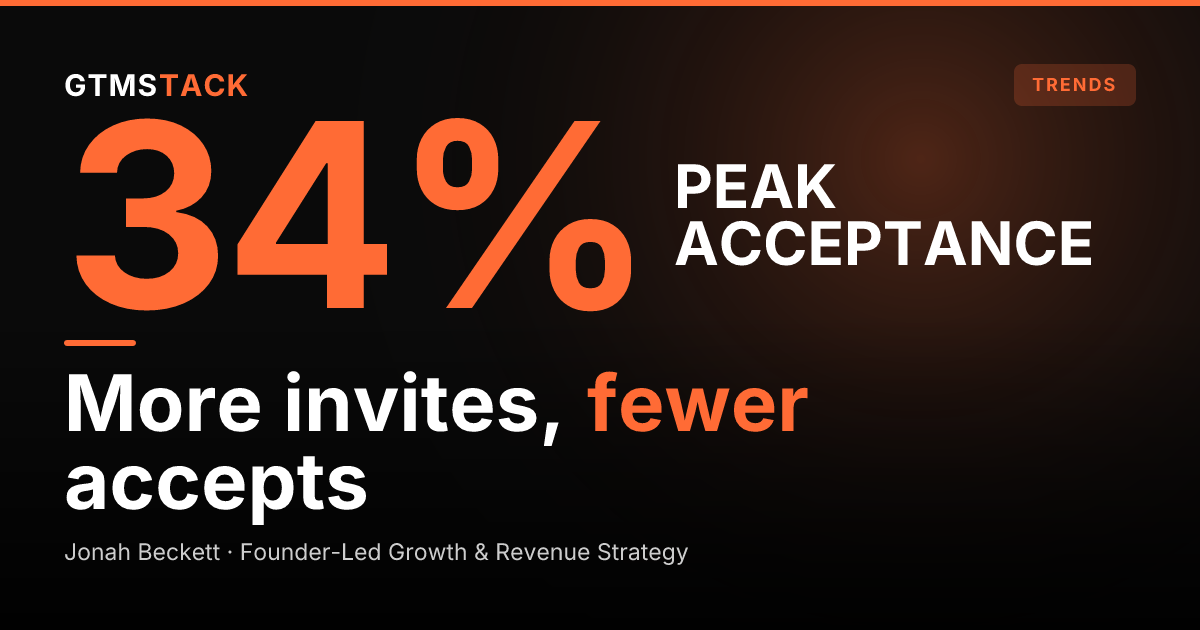
Then there is the account itself. Sustained high volume is the behavior LinkedIn's soft cap is built to catch, and pushing it invites temporary rate-limiting that stalls your whole motion. If outreach is not working, volume is often the culprit, and the fix is rarely to send more. The math is plain: a smaller, sharper list beats a firehose because a 34% accept rate on tightly targeted invites compounds into more real conversations than a 30% rate on a list you have torched.
What should you do instead of blasting invites?
Tighten your targeting before you touch your volume. Decision-makers are a minority of any list, so a 10-19 a day pace aimed only at them beats a 100-a-day pace aimed at everyone. Spend your invite budget on the people who can actually say yes.
Personalize from the prospect's activity, not a template. An invite that references a post someone published last week reads as a human noticed them, and that is what moves acceptance from spam-territory into the 30s. This is where the alternative is to personalize outreach at scale earns its keep: you keep the daily number low and let personalization, not headcount, do the scaling.
Finally, let a system pace and personalize rather than a person copy-pasting. Manual sending drifts toward volume because it is the easy lever, and a person grinding through invites will round up to whatever feels productive. A tool that holds the line at the safe band, references real prospect activity, and sequences the follow-up removes the temptation to blast. The discipline is the product.
FAQ
How many LinkedIn connection requests can I safely send per day?
Aim for 10-19 a day, which is where Reachium data shows acceptance peaks at 32.01%. That range also keeps you well inside LinkedIn's weekly ceiling and avoids the behavior that triggers temporary restrictions. Sending more rarely produces more accepts and usually produces fewer.
What is the LinkedIn weekly connection request limit?
LinkedIn's published guidance throttles invitations at roughly 100 per week, which works out to about 14 a day across a working week. The exact figure can vary by account standing, but the weekly cap is real and enforced. Treating it as a hard wall keeps your account healthy.
Does personalization change how many requests I should send?
It does not raise the number you should send, but it raises the value of each one. Personalizing from a prospect's recent posts or job change pushes acceptance higher within the same 10-19 daily band. The goal is more signal per invite, not more invites.
Will sending fewer requests really book more meetings?
Yes, because meetings come from replies and replies come from relevance, not volume. Only 7.47% of all requests earn a reply and 1.99% of accepted connections book a meeting, and both numbers improve when your list is sharp and your invites are personalized. A smaller, better-targeted list out-converts a firehose.
Want to put this into practice?
Reachium automates LinkedIn outreach, content publishing, and inbox management in one platform.
See Reachium →