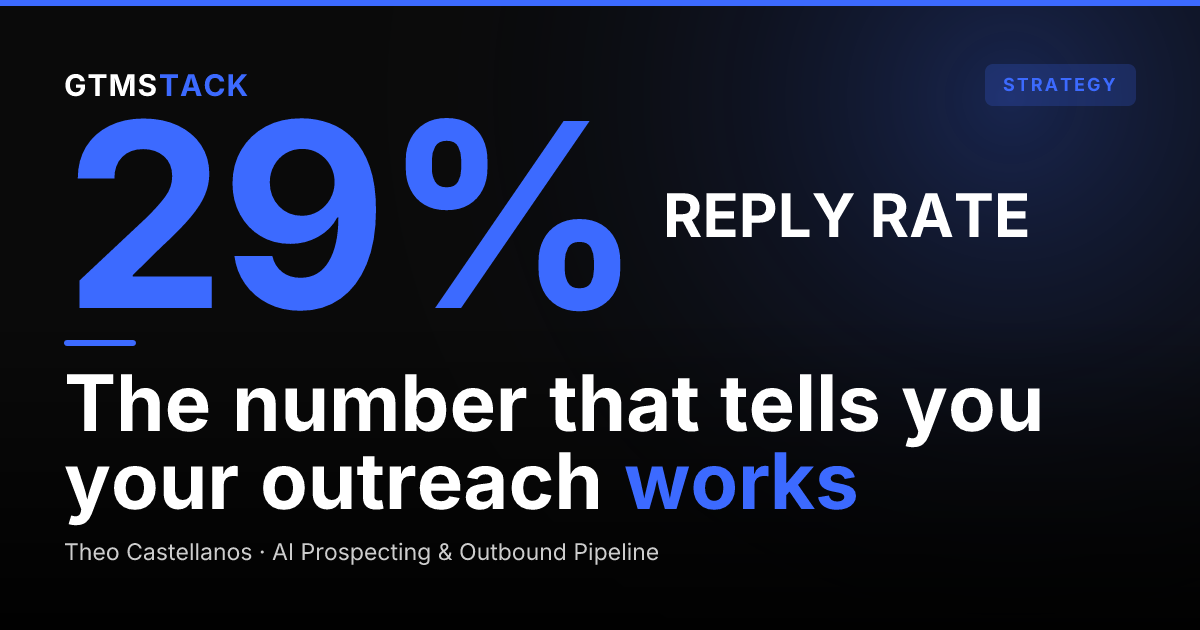
What Is a Good LinkedIn Response Rate in 2026?
By Theo Castellanos, AI Outbound & GTM. Last updated: 2026-08-06
You carry a personal quota, you do your own prospecting, and the dashboard is staring back with a number you cannot interpret. Is a 9% reply rate good, or are you quietly failing? The fear underneath the question is the one every rep has: that your messages read like a bot, get ignored, and train the algorithm to bury you. This post gives you the real benchmark band and the three levers that move it, drawn from a dataset large enough to trust.
What is a good LinkedIn response rate in 2026?
A good LinkedIn response rate in 2026 is roughly a 27.11% connection acceptance rate and a 27.55% reply rate among the people who accept, which works out to 7.47% of all requests sent earning a reply. Those are the averages in Reachium's published benchmark study of 180,155 matured connection requests sent on LinkedIn's verified API between January 2025 and August 2026, so they describe a realistic operating funnel rather than a vendor's best-case screenshot.
Read the funnel one stage at a time, because each stage has its own benchmark and its own failure mode.
| Funnel stage | Benchmark | What it tells you |
|---|---|---|
| Acceptance rate | 27.11% | Share of sent requests that connect |
| Reply rate (of accepted) | 27.55% | Accepted connections who answer a message |
| Reply rate (of all sent) | 7.47% | Sent requests that become a conversation |
| Meeting rate (of accepted) | 1.99% | Accepted connections who book a call |
Independent studies put the same numbers in roughly the same place, which matters because convergence means the benchmark is real rather than a platform artifact. Botdog's analysis of 16,492 invitations found a 37% overall acceptance rate, which lands above Reachium's 27.11%, so the healthy band runs from the high-20s into the high-30s for acceptance. When several datasets land in the same band, treat the band as the baseline and judge your funnel against it. The full window, including how the numbers shift by daily volume and over time, is laid out in our LinkedIn outreach benchmarks for 2026.
Why is my LinkedIn outreach not working?
If your outreach is underperforming the band, the cause is almost always one of three things: a list weighted toward people who cannot say yes, an opener that reads like a blast, or a daily volume high enough to suppress your accept rate. Those are the three levers, and they explain most of the variance between a rep at 5% and a rep at 11%.
Start with the list, because it sets the ceiling on everything downstream. Decision-makers are a minority of any broad B2B list, so a list weighted toward junior titles will underperform a smaller list of buyers at identical copy and volume. List quality is a benchmark input, not a one-time setup step.
The second lever is the opener, and the data on it is blunt. Expandi found that personalized connection requests hit 45% acceptance versus 15% for generic outreach across 70,130-plus campaigns, a 3x difference driven by relevance alone. The "Hi {firstName}" merge is the version that gets skipped. For the message-level diagnosis, our breakdown of why LinkedIn outreach stops working walks through the fixes in order of impact.
Want to put this into practice?
Reachium automates LinkedIn outreach, content publishing, and inbox management in one platform.
See Reachium →How do you use AI to improve your LinkedIn reply rate?
You raise your reply rate by feeding the AI real context so the opener proves a human-grade reason for reaching out, not a templated pitch. The research is consistent on the size of the lift: Built For B2B reported that cold messages personalized beyond a first-name merge reach up to 18% reply rates, double the 9% generic average, and HubSpot's own team lifted email conversions 82% with AI-powered personalization at scale. The mechanism is the same on every channel, so relevance earns the reply.
This is also why the benchmark matters more in 2026 than it did a year ago. Reachium's reply rate among accepted connections fell from 32.19% in 2025 to 21.98% in 2026 at matched maturity, while acceptance actually rose slightly over the same window. As reply rates compress, the gap between a personalized message and a merge-field blast widens, so AI personalization is no longer a nice-to-have. It is the lever keeping you inside the band while generic outreach falls below it. The same dynamic shapes how the AI-SDR debate plays out, which our comparison of AI SDR vs human SDR examines from the quota-carrier's seat.
AI also closes the research gap that limits a human rep. Reading a prospect's posts and scanning company news takes minutes per contact by hand, which is why reps skip it under quota pressure and fall back on templates. AI does that research and drafts the opener at volume, so relevance scales without the manual hours.
How do you follow up on LinkedIn with AI without being annoying?
You follow up by adding a new angle or piece of value on each touch, spacing the messages, and capping the sequence, so the thread reads as persistence with a reason rather than a nag. The data is clear that the follow-up earns its place: Instantly found the first follow-up in B2B cold email adds 40-50% more replies versus the opener alone, and the same compounding holds on LinkedIn once a connection accepts. The mistake reps make is sending the identical "just bumping this" line three times, which is the version that gets muted.
AI helps by drafting each touch off a different angle (a post the prospect just shared, a piece of company news, a question tied to their role) instead of recycling the opener. Salesloft's AI Rhythm, which prioritizes a daily action queue by buyer engagement signals, booked 22% higher meeting rates in its 2025 Forrester study, which is evidence that timing follow-ups to signals beats spraying them on a fixed clock.
Underneath the follow-up sits a volume discipline that protects both your reply rate and your account. Reachium's data surfaces a volume tax: acceptance peaked at 32.01% for accounts sending 10-19 invites a day and fell to 26.65% at 20-29 a day, so more volume actually bought fewer accepts. Following up well on a smaller, more relevant list beats blasting a bigger one. That restraint is also what keeps an account safe when you run more than one, a discipline our guide to running multiple LinkedIn accounts safely covers in full.
What is a good response rate for a specific role or audience?
The right benchmark depends on who you are reaching, because audience composition shifts the band. A rep working a defined ICP of buyers should expect to sit near the 27.11% acceptance and 27.55% reply-of-accepted averages, while a warm or lookalike audience can run well above 35% acceptance without doing anything special.
Role changes the calculus too. A recruiter chasing passive candidates is messaging people who are not actively buying anything, so the framing and the cadence differ from a quota-carrying AE, as our playbook on LinkedIn outreach for recruiters details. Judge your numbers against the current band for your segment, not last year's screenshots or someone else's vertical.
In 2026, a tightly targeted list run at a sane daily volume with AI-personalized messages beats a large list blasted at maximum speed on every metric that ends in a booked meeting. The benchmark tells you where you stand; the three levers tell you what to change.
Response rates feed the top of that funnel, and the meetings they produce should be graded on the full ladder in benchmarking AI-booked meeting quality, not on the booking count alone.
Want to put this into practice?
Reachium automates LinkedIn outreach, content publishing, and inbox management in one platform.
See Reachium →FAQ
What is a good LinkedIn response rate?
A good LinkedIn response rate in 2026 is about a 27.11% connection acceptance rate and a 27.55% reply rate among the connections who accept, based on Reachium's published measurement across 180,155 matured requests on the verified API. That nets to 7.47% of all requests sent earning a reply. Botdog measured 37% acceptance across 16,492 invitations, so the healthy band runs from the high-20s into the mid-30s for acceptance.
How do I use AI to improve my LinkedIn reply rate?
Feed the AI real context so the opener references a prospect's recent post, a job change, or company news instead of a generic merge field. Expandi found personalized requests hit 45% acceptance versus 15% for generic outreach, and personalized cold messages reach up to 18% reply rates versus 9% for templates. AI does the research and drafting at volume so the relevance scales without the manual hours.
Connection request or InMail: which gets more replies?
For prospects inside your reachable network, the connection-then-message path usually wins, because an accepted connection has opted in and replies from a warmer footing. Reachium's data shows 7.47% of all requests sent earn a reply, while an InMail opens cold to a stranger and runs lower per message. Reserve InMail for out-of-network, high-value prospects you cannot reach through an acceptance step.
Why is my LinkedIn outreach not working?
If your numbers fall below the band, the cause is usually a list weighted toward people who cannot buy, an opener that reads like a blast, or a daily volume high enough to suppress acceptance. Decision-makers are a minority of any large B2B list, so list quality sets the ceiling. Tighten the list, personalize the opener with real context, and hold daily volume in the low-20s.