What to Post on LinkedIn: A Framework That Books Meetings
By Nadia Sharpe, AI Content & Organic. Last updated: 2026-08-06
Most LinkedIn content fails for the same reason: it has no structure. People post when they feel inspired, the topics swing from a hot take to a humblebrag to a link drop, and the algorithm never learns who the account is for. A feed without a framework is noise, and noise does not book meetings.
This is a system for what to post, how long each post should run, and how organic content turns into a calendar full of calls.
What should you post on LinkedIn to get pipeline?
You should post a deliberate mix of four content types, not random updates. The accounts that turn a feed into pipeline are not the ones posting the most. They are the ones posting on purpose, where every post does a specific job and the mix as a whole earns trust before it asks for anything.
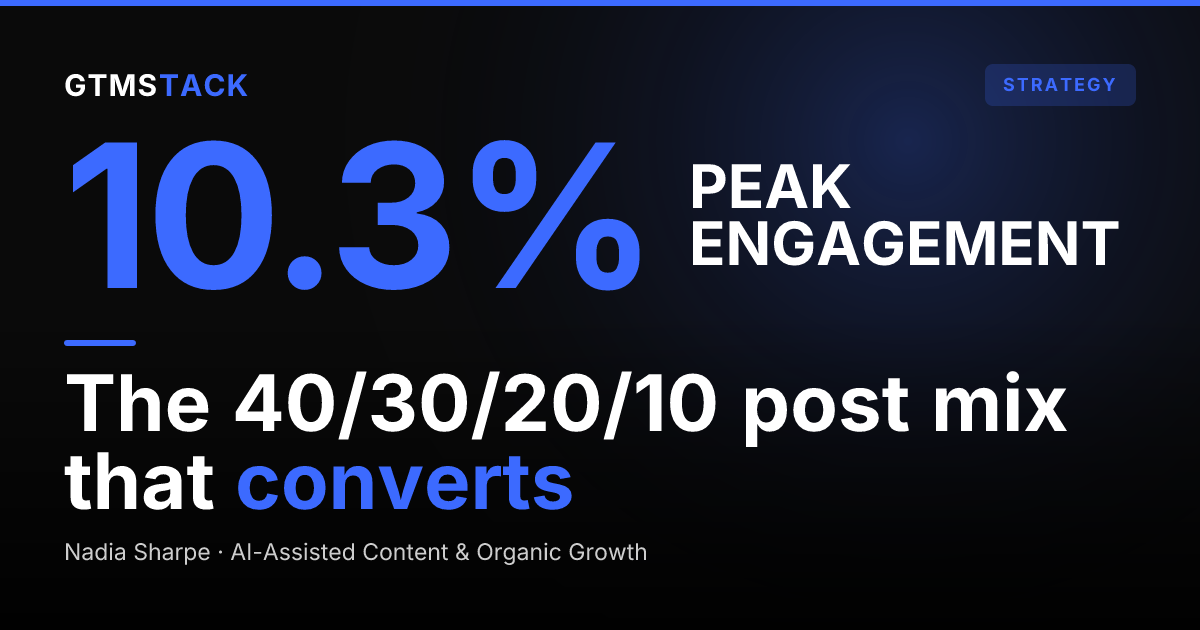
The framework is 40/30/20/10: 40% Authority, 30% Educational, 20% Social Proof, and 10% Personal. Authority establishes that you know the space, Educational gives the reader something usable, Social Proof shows the work pays off, and Personal makes you a human worth replying to. The ratio matters because each type fails on its own. All authority reads as ego, all education reads as a free course nobody asked for, and all social proof reads as a billboard.
Think of the mix as a portfolio rather than a checklist. Over a month, the four buckets compound into a profile that a buyer can scroll, understand in thirty seconds, and trust enough to accept a connection or answer a DM. That trust is the asset. Building the profile itself to deserve that scroll is its own discipline; our guide to the magnetic LinkedIn profile rebuilds the headline, About and Featured sections as a conversion page. Everything downstream, the reply and the booked call, runs on it.
How does the 40/30/20/10 content mix work?
Each bucket plays a distinct role, and the percentages keep any single role from taking over the feed.
Authority (40%) is your point of view on the industry: the trend you think is overhyped, the benchmark you disagree with, the framework you use. These posts answer "why should I listen to this person" and they earn the most reach because they invite debate. Educational (30%) is the how-to layer: a teardown, a checklist, a step you see people skip. These posts get saved and shared, which is the signal the algorithm rewards hardest. Social Proof (20%) is the receipts: a result, a client outcome described without naming names, a before-and-after. Personal (10%) is the human glue: a lesson from a failure, a behind-the-scenes choice, a reason you do this work. It is the smallest bucket on purpose, because personal posts build affinity but do not, alone, build a business.
Run those ratios across a two-week calendar and the math is simple. If you post ten times in two weeks, that is four Authority posts, three Educational, two Social Proof, and one Personal. The calendar is the framework made real. Without it, you default to whatever bucket feels easiest that morning, which is almost always Personal, and the feed slowly stops selling anything.
Want to put this into practice?
Reachium automates LinkedIn outreach, content publishing, and inbox management in one platform.
See Reachium →How long should a LinkedIn post be?
Shorter than you think. A post a reader can finish without clicking "see more" gets read in full, and completion is the signal the feed rewards. Tighter posts win, and the drop-off from a wall of text is steep enough that length is one of the highest-leverage edits you can make.
The reason is structural. LinkedIn truncates long posts behind a "see more" link, and the feed rewards posts that hold attention to the end. A 700-character post that lands one clear idea outperforms a 2,300-character post that buries three ideas, because the short one gets read in full and the long one gets a half-scroll. Length is not a style preference here. It is a distribution mechanic.
A practical rule: one post, one idea, one call to action. Open with a line that earns the click on "see more," develop a single point, and close with a question or a next step. If a draft runs past 1,200 characters, the fix is usually to cut it into two posts, not to compress it. Two tight posts that each fit the sweet spot will out-reach one sprawling one.
One slot in the mix deserves its own treatment: the lead magnet post, whose value is set less by the post than by the asset behind it. Choosing and building that asset is covered in the LinkedIn lead magnet guide.
How does organic content turn into booked meetings?
Content earns the reply, and the inbox closes it. A great post does not book a meeting on its own. It builds the trust that makes a connection request get accepted and a DM get answered. The conversion happens when you pair the 40/30/20/10 mix with a clear path from feed to conversation, and the highest-converting format in that path is the highest-converting format is the lead-magnet post, where a keyword in the comments triggers an automated resource and starts a real thread.
The mechanics back the pairing. A lead-magnet post does double duty: the comment ask feeds the algorithm so it reaches more people, and every comment opens a conversation with a named reader. Once a thread is open, outbound and content stop being separate channels. They feed the same pipeline, and you can see exactly how that pipeline performs when content and outbound feed the same funnel, see the benchmarks.
Consistency is the multiplier. A calendar beats sporadic posting because the algorithm and your audience both reward showing up. Four posts a week to the right mix, sustained over a quarter, compounds into reach that a burst of ten posts in one week never matches. And because the posts are durable assets, the same content can be optimized to get cited by AI engines, which extends each post's life well past the 24 hours it lives in the feed. Build the calendar, run the mix, attach the lead magnet, and the feed becomes the top of a funnel that ends on a call.
FAQ
What is the best LinkedIn content mix?
A 40/30/20/10 split works across most B2B accounts: 40% Authority, 30% Educational, 20% Social Proof, and 10% Personal. The ratio balances credibility, usefulness, results, and humanity so the feed builds trust without reading as a sales channel. Adjust the percentages by a few points to fit your voice, but keep all four buckets in rotation.
What is the ideal LinkedIn post length?
Short enough to read without clicking "see more." Shorter posts get read in full, while long posts get truncated and lose the reader, so land one clear idea and stop.
How often should I post on LinkedIn?
Three to five times a week is a sustainable cadence that keeps you in the feed without burning out. Consistency matters more than volume, so a steady four-posts-a-week rhythm on a calendar beats a burst of ten posts followed by silence. Pick a cadence you can hold for a full quarter and run the 40/30/20/10 mix against it.
Can AI write my LinkedIn posts?
Yes, when the AI is anchored to a framework and your voice rather than generating generic copy. Reachium's Content Generator is built on the four-bucket model, learns your brand voice, ranks ideas, and drafts posts you edit before they publish. The draft saves time, but the point of view and the final edit should stay yours.
Want to put this into practice?
Reachium automates LinkedIn outreach, content publishing, and inbox management in one platform.
See Reachium →