AI Email Subject Lines That Actually Lift Open Rates
By Nadia Sharpe, AI Content & Organic. Last updated: 2026-08-06
You are under pressure to show that your channels drive attributable pipeline, not vanity opens. The question below is not whether AI writes better subject lines. It is what the open-rate data actually rewards once you strip out the clickbait.
How much do AI email subject lines actually lift open rates?
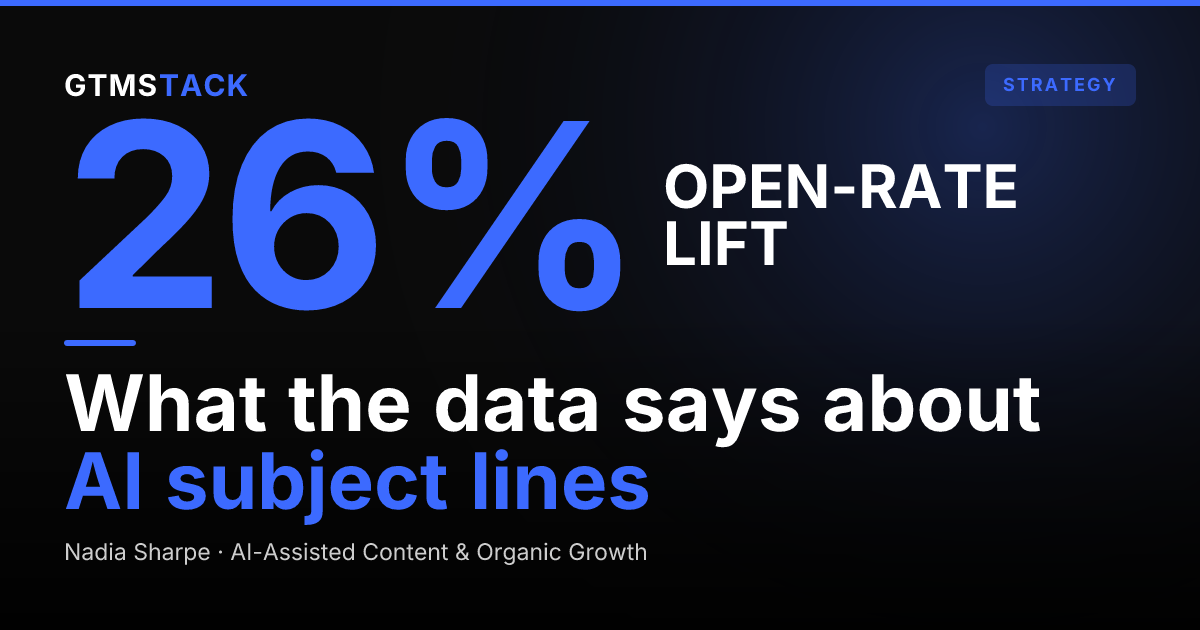
AI email subject lines lift open rates by a typical 5-10%, and by up to 22-26% in the best-measured comparisons, which is real but smaller than the headlines suggest. Knak's 2026 email statistics report found AI-generated subject lines increase open rates by up to 22%, with typical improvements landing in the 5-10% band. Instantly's email sequence benchmarks put the upper figure slightly higher, reporting a 26% increase in open rates for organizations that use AI to generate and optimize subject lines versus manually written alternatives.
Those numbers are a lift on top of an already-high baseline. HubSpot's email benchmarks show B2B email marketing averages a 39.5% open rate, with B2B Services at 39.48% and SaaS at 38.14%, so a 5-10% relative lift moves a 39% open rate to roughly 41-43%, not to a fantasy 70%. The lift is worth capturing, but it does not rescue a campaign that is fundamentally mistargeted or undelivered.
The trap is treating the subject line as the whole game. Open rate is a leading indicator, not pipeline. Average B2B email click-through rates run 1.9-3.4% per Mailchimp, and average B2B cold email reply rates sit at 3.43% per Instantly, with only the top 10% of senders clearing 10.7%. A subject line that wins the open but the body that loses the reply produces a prettier dashboard and the same empty pipeline. AI helps most when it improves relevance to a specific reader, the same discipline that powers good personalized outreach at scale, rather than when it manufactures curiosity gaps that train readers to ignore you.
Why does deliverability set the ceiling before any subject line helps?
A subject line cannot lift an open rate on an email the reader never sees, and deliverability is where most B2B programs quietly lose. Landbase's deliverability research found only 33.4% of the top one million websites maintain valid DMARC records, and 85.7% of domains do not enforce DMARC with a protective policy of quarantine or reject. That is a structural inbox-placement problem that no amount of AI phrasing fixes.
The gap between authenticated and unauthenticated senders is large. Instantly's analysis of Gmail and Yahoo bulk-sender requirements found average commercial email programs achieve an 89% inbox placement rate, while non-compliant bulk senders see spam-folder delivery of 22-34%. Run the math against a 39.5% open-rate baseline: a third of your audience never gets the chance to open, so the channel is leaking before the subject line is even read. If you are not sure your domain is configured correctly, our breakdown of DMARC, SPF, and DKIM for marketers covers the authentication setup that earns inbox placement in the first place.
The order of operations is the lesson. Authenticate the domain, warm the sending infrastructure, and prove inbox placement, then optimize the subject line. A marketing leader who reports a subject-line A/B win on a domain that lands a third of its sends in spam is optimizing the wrong layer. For the full benchmark picture on opens, replies, and bounces, our cold email benchmarks for 2026 give you the numbers to model a realistic funnel against.
Want to put this into practice?
Reachium automates LinkedIn outreach, content publishing, and inbox management in one platform.
See Reachium →What does the data say about AI subject lines beyond clickbait tricks?
The data rewards relevance and specificity, not curiosity-gap clickbait, because the metric that compounds is the reply, not the open. AI's measurable advantage is generating and ranking many variants against your audience and surfacing the framing that earns a response, which is a relevance engine, not a trick generator. Instantly's finding that AI-optimized subject lines lift opens by 26% comes from optimization against real performance data, not from manufactured intrigue.
Clickbait fails on the metric that pays. A "you won't believe this" or fake-reply subject line can spike a single open rate while training the reader to distrust your sender name, which drags down the next ten sends. Because average B2B click-through runs only 1.9-3.4%, the small population that opens is the one you cannot afford to burn. The durable AI play is to feed the model your best-performing prior subjects and a clear description of the reader, then let it propose variants that stay specific and honest.
Email is not the only channel where this relevance discipline pays, and for warm audiences it is often not the best one. LinkedIn converts at 277% higher rates than Facebook and X, and 89% of B2B marketers use it for lead generation, per Sopro. The same AI personalization that lifts an email subject line lifts a LinkedIn opener even more, because the message lands in a checked inbox rather than a contested spam filter. To see how the open and reply economics compare on that channel, our LinkedIn outreach benchmarks for 2026 lay out the acceptance and reply rates side by side.
How should a B2B team build an AI subject-line workflow that proves pipeline?
Build the workflow to optimize for replies and meetings, not opens, and instrument every stage so you can attribute pipeline rather than admire a dashboard. Email ROI remains strong at $36-$42 earned per $1 spent per Verified.email, so the channel is worth running well, but only a workflow tied to downstream conversion proves that return to a board.
Run the build in a fixed sequence so each layer earns the next:
- Authenticate first, fixing DMARC, SPF, and DKIM so the email reaches the inbox, since 89% inbox placement for compliant senders beats 22-34% spam delivery for non-compliant ones.
- Feed AI your top historical subject lines plus a precise reader description, then generate and rank variants instead of writing one-off lines by hand.
- A/B test on a meaningful sample, hold every other variable constant, and judge winners on reply and meeting rate, not open rate alone.
- Tie each send to a pipeline checkpoint (reply, qualified conversation, booked meeting) so the subject-line lift connects to revenue, not vanity opens.
The leaders who win budget report the meeting, not the open. With 75% of marketers now using AI in their operations per Salesforce, the differentiator is no longer access to an AI subject-line generator; it is the discipline to point that AI at relevance and measure the result at the pipeline line. That move turns a 5-26% open lift into attributable revenue instead of a slide that says nothing about pipeline.
FAQ
Do AI email subject lines actually increase open rates?
Yes, AI-generated subject lines increase open rates by up to 22% per Knak and by 26% in Instantly's optimization data, with typical improvements in the 5-10% range. The lift is real but sits on top of a high B2B baseline of about 39.5%. It comes from ranking many variants against your audience, not from clickbait phrasing.
Why are my open rates low even with good subject lines?
Low open rates usually point to deliverability, not phrasing, because a subject line cannot lift an open on an email that lands in spam. Only 33.4% of top sites enforce DMARC, and non-compliant senders see 22-34% spam delivery versus 89% inbox placement for compliant ones. Fix domain authentication first, then optimize the subject line.
Should I optimize subject lines for open rate or reply rate?
Optimize for reply rate, because the open is a leading indicator while the reply is the metric that connects to pipeline. Average B2B click-through runs 1.9-3.4% and cold-email reply averages 3.43%, so the small population that opens is the one you cannot afford to burn with clickbait. Judge AI variants on replies and booked meetings.
Is email or LinkedIn better for reaching B2B decision-makers?
For warm, personalized conversations, LinkedIn often wins because it lands in a checked inbox with no spam folder to clear, and it converts at 277% higher rates than Facebook and X per Sopro. Reachium platform data shows a 27.11% connection acceptance rate and a 27.55% reply rate of accepted connections, well above the 3.43% cold-email reply benchmark. Email still earns $36-$42 per $1 spent, so most B2B teams run both.
Want to put this into practice?
Reachium automates LinkedIn outreach, content publishing, and inbox management in one platform.
See Reachium →